How to Buy Second-Hand Golf Clubs in 2026
A new premium iron set now runs R16,000–R25,000, and a current-generation driver from a major brand will set you back R7,000‑R11,000. Kit out a full bag from scratch and you're easily looking at R50,000 before you've hit a single ball.
The good news is golf clubs depreciate fast, and last year's tech is barely distinguishable from this year's on the course. Buy smart, secondhand, and you can build a genuinely good bag for a third of that - if you know what you're looking for.
Why buy used - and what you should actually pay
Golf gear depreciates like a car the moment it leaves the shop, but it doesn't perform like one. A 2‑3 year old driver or iron set is, for the vast majority of golfers, indistinguishable from the current model on the course - the swing speed and mishit forgiveness gains between generations are small, while the price gap is not.
The used market is also unusually strong for wedges right now: because wear is easy to spot (grooves either look sharp or they don't), buyers can shop confidently, and a clean secondhand wedge often trades close to retail. Irons from the major brands (TaylorMade, Callaway, Titleist, Ping) tend to hold their performance for 5+ years, which is exactly why 2‑3-generation-old sets are the sweet spot for value.
Rule of thumb: target clubs that are two to three generations old, in good condition, and pay 40-60% of the original retail price. Don't pay more than that unless the club is genuinely current-generation or tour-preferred.
- Driver: 40-55% of retail. Depreciates fastest: marketing cycles push a "new" driver every year even though the gains are marginal.
- Irons (full set): 45-65% of retail. Hold their performance longest; premium brands stay strong for 5+ years.
- Wedges: 55-75% of retail, often near-retail if the grooves are sharp. Wear is visible and easy to grade, so buyers pay with confidence.
- Putter: 50-70% of retail. Feel-driven, not tech-driven - an older putter performs identically to a new one.
- Fairway woods / hybrids: 45-60% of retail. Similar depreciation curve to drivers, slightly slower.
One more thing worth knowing if you're selling as well as buying: private, peer-to-peer sales typically fetch 30-50% more than a shop trade-in on the same club, because the retailer needs their own margin to resell it.
Know your numbers before you shop
The single biggest mistake buyers make with used clubs is chasing a good price on the wrong specs. A cheap driver that doesn't match your swing will cost you more in lost strokes than the money it saved. Before you start browsing listings, know:
- Shaft flex - Regular, Stiff, X-Stiff (or Ladies/Senior) should roughly match your swing speed. Buying a listing without a stated flex is a guess.
- Length - Standard lengths vary by height and setup. A club that's the wrong length changes your lie angle at impact even if everything else is right.
- Lie angle - Determines whether the clubface points left, right, or straight at impact. Off-the-rack clubs are built for an "average" golfer; if you've been fitted before, you already know your number.
If you've never been fitted, a launch monitor session or a quick check with a PGA professional before you buy is one of the highest-value 30 minutes you can spend - portable launch monitors and swing apps have made this far more accessible and affordable than it used to be, so there's little excuse to skip it. Armed with your numbers, you can filter used listings intelligently instead of guessing.
The pre-purchase inspection checklist
Whether you're viewing clubs in person or messaging a seller for photos, work through this list before you commit:
- Clubface - Look for deep scratches, dents, or cracks. On irons and wedges, check the grooves: worn-down grooves kill spin and control, especially from the rough.
- Clubhead - Inspect for cracks around the edges and any signs of impact damage beyond normal wear.
- Hosel - Check where the shaft meets the clubhead. Damage here affects the connection between the two and is a common failure point on well-used clubs.
- Shaft - Run your hand along its length. It should be straight, with no bends, rust, or (on graphite) chipping or splintering.
- Grip - Should feel tacky, not slick or hardened. Regripping is cheap (budget it into your offer if needed) but a worn grip is also a clue about how much the club was used.
- Serial number - Present and legible on premium drivers and irons. It's your best defence against counterfeits (see below).
- Actual photos, not stock images - Ask for a photo of the real club, ideally several angles including the sole and face close-up. A seller who can't or won't provide real photos is a red flag on its own.
Where to buy safely - and how to avoid scams
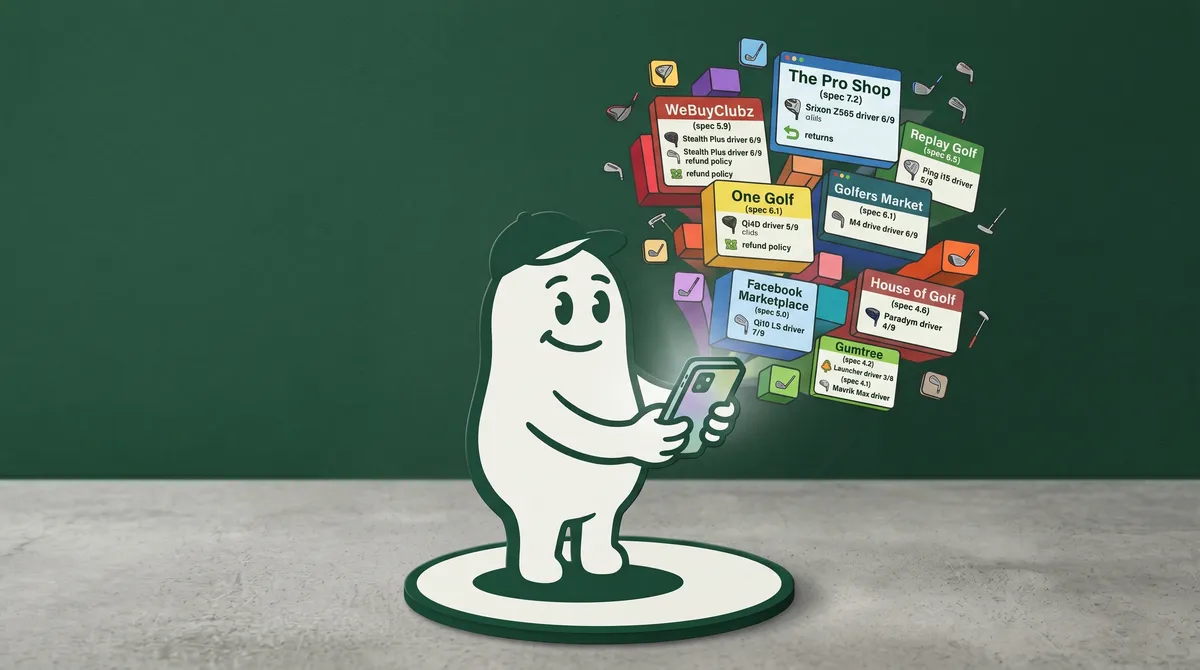
You've got three broad options: pro shops and used-club retailers, general marketplaces (Facebook Marketplace and Gumtree), and dedicated golf resale platforms. Each has a trade-off.
Pro shops and used-club retailers inspect and grade what they sell, so the condition is reliable - but margins mean prices sit at the top of the 40–60% range.
General marketplaces have the biggest selection and the lowest prices, but zero vetting. This is where most counterfeit and misrepresented listings show up.
Dedicated golf resale platforms (like Second Nine) sit in between: peer-to-peer pricing, but with buyer protection built in.
Red flags to walk away from
- A price dramatically below the going rate for that model - especially on a popular driver or iron set.
- Stock or scraped photos instead of pictures of the actual item.
- A seller who won't answer basic questions about condition, serial number, or provenance.
- Pressure to pay outside the platform (bank transfer to a personal account, no buyer protection) to "save on fees."
- No serial number on a club type/brand that should have one.
Pay in a way that protects you
The single best protection against both scams and counterfeits is using a payment method that holds funds until you've confirmed the item matches its description - an escrow service, or a marketplace with built-in buyer protection, rather than a direct bank transfer to a stranger. This is the whole reason Second Nine processes payments through TradeSafe's escrow system: your money isn't released to the seller until you've received and can inspect the clubs, which removes almost all of the risk covered above in one step.
What's worth buying used in 2026 - and how to build a set
Not every club depreciates at the same rate, and you don't have to buy a whole bag at once.
Best value right now:
- Wedges - the strongest used category for value buyers. Grooves are easy to grade, so condition is transparent.
- Irons from TaylorMade, Callaway, Titleist and Ping - older "game-improvement" sets remain genuinely forgiving; a set that's 2‑3 generations old plays almost identically to current models for most golfers.
- Drivers 2‑3 years old - the depreciation curve is steepest here, which is good news for buyers. A driver one or two cycles behind current loses little in real performance.
If you're building a bag from nothing, prioritise in this order:
- Driver and putter first - these two clubs influence your score the most, in the most directions (off the tee and on the green), so they're worth getting right before anything else.
- Irons next - buy a full set together from one era/model rather than mixing generations, for consistent feel and yardage gaps.
- Wedges and fairway woods last - easiest to pick up individually and cheapest to get right, since condition is so visible.
Buying in stages also means you can save up and get properly fitted for each piece rather than compromising on a bundled set to hit a single budget.
Before you click "buy"
- I know my shaft flex, length, and lie angle (or have been fitted)
- I've compared the asking price against the 40-60%-of-retail benchmark for this club type
- I've seen real photos of the actual item - face, sole, hosel, shaft
- I've checked for a serial number where the brand/model should have one
- I'm paying through a method that protects me if the item doesn't match its description
Second-hand doesn't mean second-best - it means the same performance for a fraction of the price, as long as you know what to check. Ready to start shopping? Browse verified second-hand clubs on Second Nine, where every purchase is protected by escrow from click to collection.